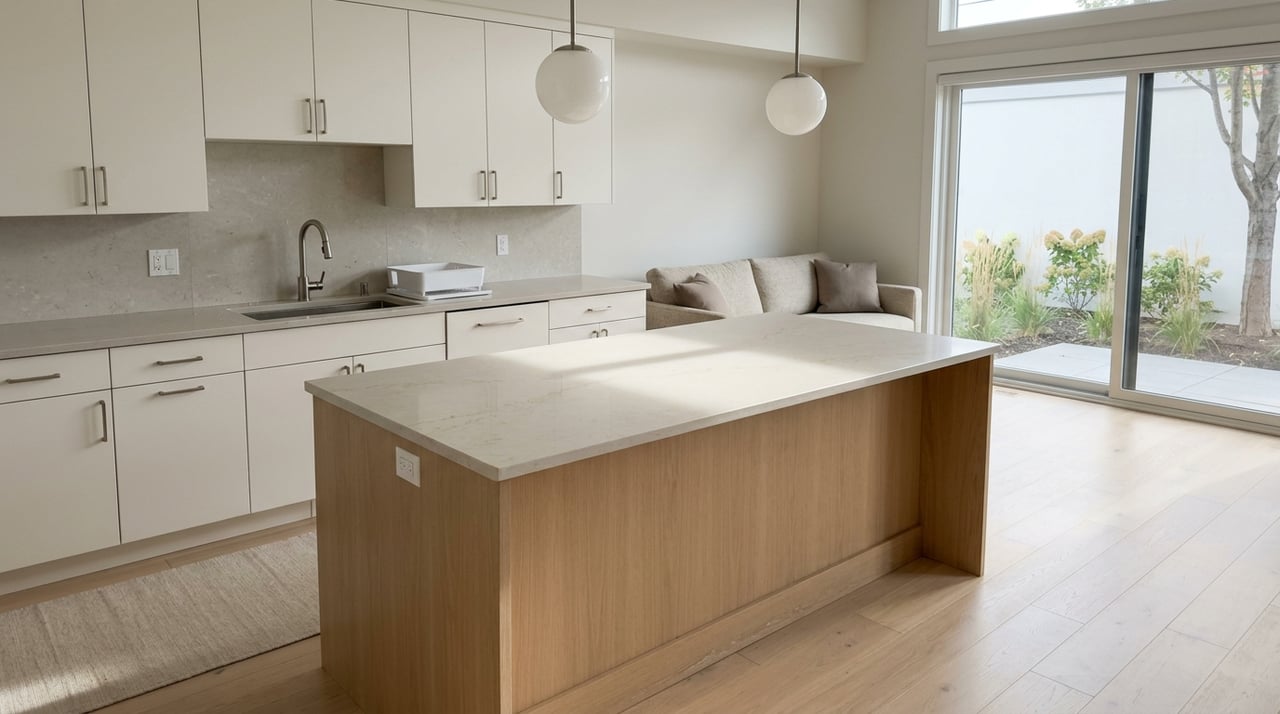
Milton New Build vs Resale: Compare the Real Costs
July 2, 2026
July 2, 2026
Buying in Milton can feel simple until you compare a shiny new release to a polished resale and realize the sticker price only tells part of the story. If you are trying to decide which path gives you better value, you need more than a quick glance at list prices. You need a clear way to compare cash required, monthly carrying costs, and what you will actually own over time. Let’s dive in.
In Milton, affordability pressure is real. Milton’s official planning documents place the 2025 income-based affordable purchase benchmark at $535,400, while the average resale price of a house in 2025 was $964,086. The same document says the average market rent in Milton in 2024 was $1,703 per month.
That gap matters because many buyers focus on purchase price first and monthly cost second. In practice, the better choice is often the property with the lower total cost of ownership over the time you expect to stay. That means comparing more than just new versus resale.
Before you build a worksheet, it helps to know how new and resale pricing compares by property type in Milton. Halton Region’s 2024 State of Housing Report shows that the spread changes depending on what you are buying.
For average new sales in Milton, single and semi-detached homes came in at $1,371,895, townhouses at $854,583, and apartments at $544,313. Average resale prices were $1,281,240 for single and semi-detached homes, $877,078 for townhouses, and $648,619 for apartments.
The key takeaway is simple: new is not always more expensive. In that report, new townhouses and new apartments were cheaper on average than resale, while new single and semi-detached homes were higher.
A common mistake is comparing any new build to any resale without adjusting for size, layout, and product type. That can create a false sense of value either way.
For example, a current Milton new-build townhome example at Hawthorne East Village is a 2,151-square-foot rear-lane townhome starting at $815,035, or about $378.90 per square foot. A current resale freehold townhome example at 525 Cavanagh Lane is listed at $699,900 with 1,513 square feet, and the listing advertises $479.18 per square foot.
That does not mean every new build is the better deal. It means your comparison needs context. When size, plan, and product differ, price per square foot can point you in a very different direction than headline price alone.
Condo comparisons in Milton can be even trickier. A current new condo release at Mile & Creek shows starting prices in the mid-$500s, occupancy in Fall 2026, price per square foot from $904, a 10% deposit structure, one year free maintenance, free assignment, and capped development charges at $0.
A current resale condo example at 610 Farmstead Drive is listed at $689,900 for 900 to 999 square feet, with $457 per month in maintenance fees and $2,495 per year in property taxes. That monthly fee line matters because condo carrying costs can change your budget quickly, even if the purchase price looks manageable.
If you want a clean new-build versus resale comparison in Milton, build your worksheet around these line items:
This kind of worksheet gives you a real-world comparison instead of a marketing comparison. It also fits the way financially disciplined buyers should approach Milton’s market.
For many buyers, the mortgage payment is the biggest line item, so start there. Using the examples in the research, the gap between resale and new may be noticeable, but it is not always dramatic enough to decide the issue by itself.
An illustrative resale example at $699,900 with 20% down, a 5% mortgage rate, and a 25-year amortization works out to about $3,273 per month in principal and interest. An illustrative new-build example at $815,035 with the same assumptions works out to about $3,812 per month.
That is a difference of about $539 per month before taxes, fees, insurance, and utilities. Depending on the product type and your timeline, that difference may or may not outweigh the benefits of buying new.
Property tax is often underestimated, especially by first-time buyers. Milton’s 2025 budget says the average residential home assessed at $600,000 can expect to pay about $4,952 in total property taxes in 2025.
That works out to roughly $413 per month. Your actual amount will depend on the property, but this is a useful local anchor when you are building a monthly carrying-cost estimate.
If you are comparing condos, monthly maintenance can be a major budget driver. In the Milton resale condo example above, the maintenance fee is $457 per month.
That means a resale condo may carry a noticeably higher monthly cost than a freehold property with a similar mortgage payment. On the other hand, some new condo offerings may include temporary incentives such as one year free maintenance, which can improve the early cash flow picture.
This is where many buyers get surprised. A resale purchase usually has a cleaner timeline from accepted offer to closing, while a new build often requires cash long before final ownership is complete.
A current Milton new-build deposit schedule at Mile & Creek is structured as $5,000 on signing, the balance to 5% in 30 days, 2.5% in 120 days, 2.5% in 240 days, and 5% on occupancy. With occupancy shown as Fall 2026, you are tying up funds well before final closing.
The question is not only how much you put down. It is also when that money leaves your account.
If you buy resale, your deposit is typically committed over a much shorter period before closing. If you buy new, staged deposits can affect your cash reserves, investing plans, and flexibility for many months.
For freehold new homes, Tarion says deposits are protected up to $60,000 for homes priced at $600,000 or less, or 10% of the purchase price up to $100,000 for homes above $600,000. Tarion also encourages buyers to register their purchase so the agreement is on file and coverage can be confirmed.
That does not replace proper due diligence, but it is an important part of your risk review if you are buying pre-construction or a new freehold home.
If you are looking at a new condo in Milton, interim occupancy is one of the most important concepts to understand. Tarion explains that interim occupancy can happen before final title registration.
During that period, your monthly occupancy fee covers interest on the unpaid balance, estimated municipal taxes, and projected common expenses. It is also not credited to the final purchase price, which is why this stage needs to be built into your numbers from the start.
By contrast, resale timing is usually more straightforward. On a resale closing day, you take legal possession and the lawyer handles payment and registration, which makes the timeline easier to pin down.
Ontario land transfer tax should always be in your worksheet. The rates are 0.5% up to $55,000, 1.0% from $55,000 to $250,000, 1.5% from $250,000 to $400,000, and 2.0% above $400,000 up to $2 million.
First-time buyers may qualify for a refund of up to $4,000. That refund can make a meaningful difference to upfront cash required.
For the illustrative resale example at $699,900, Ontario land transfer tax is $10,473 before any first-time buyer refund, or about $6,473 net if you qualify for the full refund. For the illustrative new-build example at $815,035, the tax is listed at $6,714.80 before any first-time buyer refund, or about $2,714.80 net if you qualify for the full refund.
The larger point is not just the exact tax number. It is that closing cash needs can vary more than buyers expect, and those needs should be modeled early.
New construction often looks attractive because the base price is clearly presented. But your actual cost may rise if you add structural, finish, or appliance upgrades.
A Milton detached-home example at 799 Apple Terrace showed $74,080 in upgrades and features on a $1,918,990 base price. Those upgrade items included structural changes, electrical, kitchen, bathroom, plumbing, appliances, and flooring.
You may not spend that much on every purchase, of course. Still, it shows why the base price is only the starting point for many new-build buyers.
When you review new construction pricing, confirm how HST is being handled. Mattamy’s pricing policy says the base price is inclusive of GST/HST net of the new housing rebate.
That means the published number may already assume rebate treatment. If you are comparing a new build to resale, make sure you understand whether the advertised price already reflects that assumption so your worksheet stays accurate.
The best deal in Milton is not automatically the cheaper listing, the newer finish package, or the lower advertised deposit. It is the option that fits your cash flow, your time horizon, and your expected total ownership cost.
A resale may win if you want a fixed timeline, simpler closing sequence, and clearer monthly carrying costs from day one. A new build may win if the product type is priced well, the layout better fits your needs, and you are comfortable with staged deposits, delayed occupancy, and possible upgrade spending.
If you are torn between new and resale, ask these questions:
If you can answer those questions with real numbers, your decision becomes much clearer.
When you are looking at Milton specifically, the market data supports a measured approach. Product type matters. Deposit timing matters. Monthly fees matter. And sometimes the option that looks more expensive at first glance can work better once you compare the full cost picture.
If you want help building a side-by-side worksheet for a Milton new build and a resale option, Paul Breakey can help you model the numbers clearly so you can move forward with confidence.
Stay up to date on the latest real estate trends.

With a background in finance and business operations, Paul brings a strategic approach to real estate, helping clients make informed decisions. His passion for community and commitment to client-focused service make him a trusted partner in achieving your real estate goals.
PAUL BREAKEY CPA, CA

OAKVILLE ON L6M 2W2
OAKVILLE ON L6J 1J3