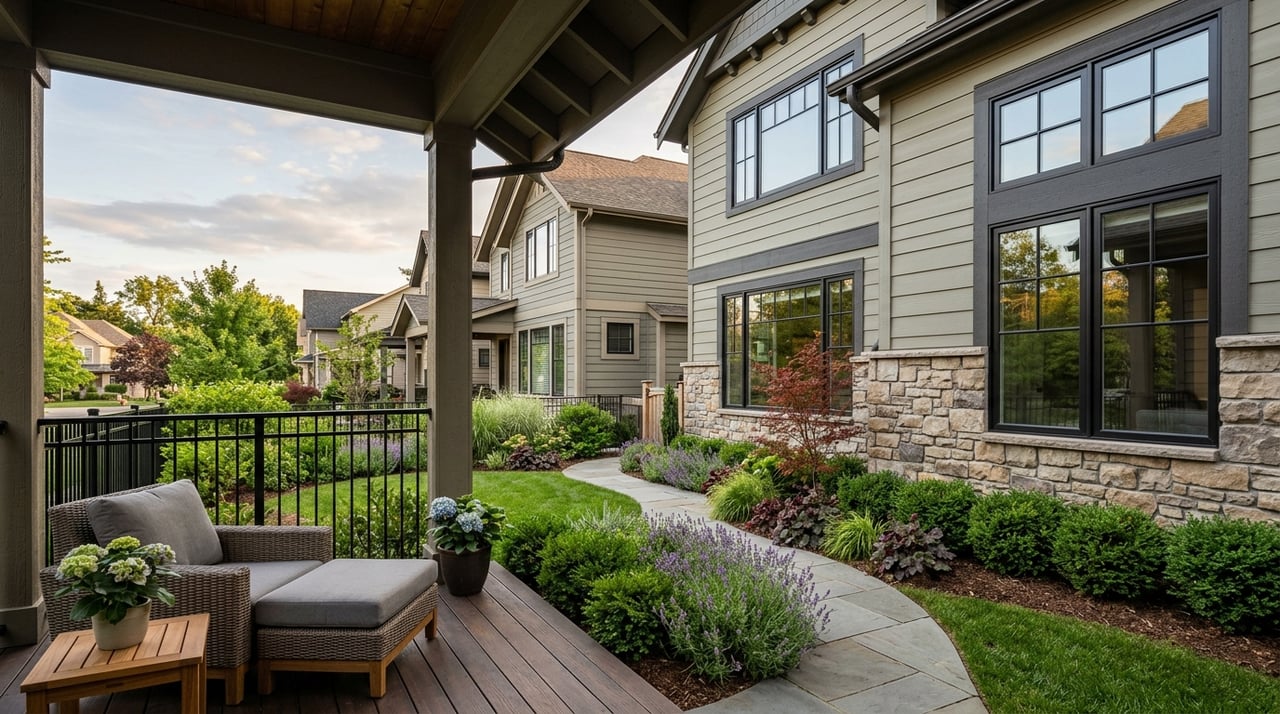
River Oaks Townhome vs Detached: How to Compare
July 23, 2026
July 23, 2026
If you are trying to choose between a townhome and a detached home in River Oaks, the real question is not just price. It is how much space, flexibility, and monthly carrying cost you want to take on for your next chapter. In a neighbourhood with a wide mix of housing types, the smartest decision comes from comparing the right sub-types, understanding the numbers, and matching the home to your day-to-day life. Let’s dive in.
In River Oaks, “townhome” can mean very different things. A stacked condo townhouse, a freehold row townhome, and a detached house each sit in a different part of the market, both in price and in how you live in the space.
That matters because broad neighbourhood averages can blur the real tradeoffs. If you compare a compact stacked unit on Post Road to a larger freehold row home on a mature lot, you are not really comparing the same product.
River Oaks also has a strong owner-occupied profile, with Wahi showing 78% owner occupancy and 24,160 residents. Oakville planning materials describe Sixth Line as a key corridor through the area, with a mix of residential densities and community uses, which helps explain why housing options vary so much within the same neighbourhood.
The lowest entry point in River Oaks today is typically the condo or stacked townhome segment. Current examples on Post Road include a 900 to 999 square foot stacked townhouse listed at $509,900 with a $421 monthly maintenance fee, and another similar unit listed at $599,000 with a $377 monthly maintenance fee.
These homes usually trade land and basement space for convenience and a lower purchase price. The current Post Road examples offer compact layouts and balcony space, which can work well if you want ownership in Oakville without stretching into a larger monthly payment.
For many buyers, this is the most practical way to enter River Oaks. It can also make sense if you value a simpler upkeep routine and are comfortable with condo fees as part of your monthly budget.
A stacked condo townhouse often works best when you want a lower purchase price and predictable exterior upkeep. In River Oaks, that usually means a smaller interior footprint, no basement, and some monthly maintenance fees.
The tradeoff is straightforward. You may spend less to get into the neighbourhood, but you give up some storage, private outdoor space, and renovation flexibility compared with larger home types.
Freehold row townhomes in River Oaks tend to sit in the middle tier. Wahi’s current inventory shows freehold-style townhomes around $949,000 to $1,019,000 on streets such as Stefi Trail, New Wood Drive, and The Greenery.
A recent sold example on Strawfield Court shows the appeal of this category. It offered 1,500 to 2,000 square feet on a 23.12 by 92.11 foot lot, plus an attached garage and private yard, which is a meaningful step up in space and flexibility from a stacked layout.
For buyers who want more room but are not ready for the full detached premium, this is often the sweet spot. You may still stay below detached pricing while gaining a more family-flexible layout and some outdoor space of your own.
This category often works well for move-up buyers. You get more separation between living areas, more storage potential, and a yard that supports everyday use without the larger purchase price of a detached property.
It is also where careful comparison matters most. Lot dimensions, age, interior updates, and whether there are any fees attached to the property can all change value quickly.
Detached homes in River Oaks currently ask materially more than townhomes, but the price gap is not just about the word “detached.” It is also driven by larger lots, more bedrooms, basement space, parking, and overall square footage.
Current examples include 215 Roxton Road at $1,419,000 for 2,000 to 2,500 square feet on a 26.02 by 96.74 foot lot, 2048 Sixth Line at $1,639,900 on a 50 by 108 foot lot, and 105 River Glen Boulevard at $1,799,998 for 3,500 to 5,000 square feet.
Recent sold data shows a similar spread. Wahi reports detached sales at $1,310,000, $1,448,000, $1,680,000, and $1,905,000, while recent townhouse sales included $765,000 and $817,500.
In practical terms, detached homes usually offer the most room to adapt over time. The Roxton Road example includes a full basement, two parking spaces, and four bedrooms, which can support changing needs more easily than a smaller attached home.
If you think ahead to storage, home office space, guest rooms, or future renovations, detached homes often create more options. That extra flexibility is one reason the detached premium can feel justified for some buyers.
Purchase price gets the attention, but monthly carrying costs often decide what feels comfortable. In River Oaks, the jump from stacked townhome to freehold townhome to detached home can be significant once you layer in mortgage payments, property tax, and maintenance.
Using an illustrative scenario of 20% down, a 25-year amortization, and a 5.0% mortgage rate, the monthly mortgage payment on a $509,900 stacked condo townhouse is about $2,385. With about $4,339 in annual property tax and a $421 monthly maintenance fee, the non-insurance carrying cost is about $3,167 per month.
For a $925,000 freehold townhome, the same scenario produces about $4,326 per month in mortgage payments and about $7,871 in annual property tax. That puts the non-insurance monthly carrying cost near $4,982 before insurance and utilities.
For a $1,419,000 detached home, the same model gives a mortgage payment of about $6,636 per month and about $12,075 in annual property tax. That brings the non-insurance monthly carrying cost to about $7,643.
Oakville’s 2026 residential tax rate is 0.850960%, and Halton Region notes that property tax is based on assessed value and the approved rate. In simple terms, as home values rise, tax bills can rise quickly too.
That means your monthly comparison should not stop at the mortgage payment. A lower-priced home with a maintenance fee can still be less expensive each month than a detached property with a much larger tax bill.
Ontario land transfer tax rises with the purchase price as well. On the examples above, the tax would be about $6,673 on a $509,900 purchase, about $14,975 on a $925,000 purchase, and about $24,855 on a $1,419,000 purchase before any eligible first-time buyer refund.
That does not change your monthly carrying cost, but it can affect how much cash you need to close. If your budget is tight, this is one more reason to compare home types carefully before you shop.
Numbers matter, but so does how the home fits your routine. A stacked townhome often gives you ownership with less upkeep, while a freehold row or detached home usually gives you more room for storage, hobbies, work-from-home needs, and outdoor use.
River Oaks supports a range of lifestyles because the neighbourhood has strong recreation infrastructure. River Oaks Community Centre at 2400 Sixth Line includes a twin-pad arena, fitness centre, courts, and community rooms, and the Town places the Munn’s Creek and Shannon Creek Trail system in the River Oaks area.
The Town’s 2026 construction list also includes a renovation for River Oaks Community Centre Rink A, Munn’s Creek Phase 2, and work on Sixth Line. If you are choosing between home types, these local projects may shape how you think about convenience, recreation access, and near-term traffic patterns.
If you are thinking a few years ahead, flexibility can be just as important as today’s layout. Oakville approved Official Plan Amendment 78 on April 20, 2026, adding a town-wide housing policy section while maintaining goals around neighbourhood stability and local character.
The Town’s housing strategy work has also included a proposal to permit four units per property town-wide, with examples such as a primary home, basement suite, and garden suite or carriage house. For buyers considering future upgrades, this policy direction is worth watching.
In practice, detached homes usually provide more physical room for additions, basement suites, or accessory structures. That said, actual permissions still depend on the specific zoning, lot conditions, and permit requirements for the property you buy.
The cleanest way to evaluate River Oaks is to treat it as a three-market story. There is the stacked condo townhome market for cost-conscious buyers, the freehold row townhome market for buyers who want more space without a full detached jump, and the detached market for buyers who want the most room and flexibility.
When you compare options, start with:
This approach gives you a much clearer answer than comparing neighbourhood averages alone. In a place like River Oaks, the label on the listing matters less than the details behind it.
If you want a finance-minded way to make the decision, think about both cost today and flexibility tomorrow. The best choice is the one that supports your budget now without boxing you in later.
If you are weighing a move in River Oaks and want a clear, numbers-first view of your options, Paul Breakey can help you compare sub-types, carrying costs, and local sold data so you can buy with confidence.
Stay up to date on the latest real estate trends.
With a background in finance and business operations, Paul brings a strategic approach to real estate, helping clients make informed decisions. His passion for community and commitment to client-focused service make him a trusted partner in achieving your real estate goals.
PAUL BREAKEY CPA, CA

OAKVILLE ON L6M 2W2
OAKVILLE ON L6J 1J3